Wednesday, December 2, 2009

Day 25


Outline:


b. Julia will cover the first 3 bullets, Emily the second 2, and me the last 2.

c. What are your 5 best references - (so far) - you can have more!!

Spam laws: http://spam.abuse.net/ http://www.ftc.gov/spam/

How to get rid of spam: http://email.about.com/od/spamandgettingridofit/Spam_and_How_to_Get_Rid_of_It.htm

How to track spam: http://www.rahul.net/falk/mailtrack.html

Spam News: http://www.topix.com/news/spam


Monday, November 30, 2009

Day 24

6. What is spam (not including scams like Phishing, Nigerian 419 or chain letters) and how does it work? Does anyone really buy the products advertised in spam?


  • Spam floods the internet with multiple copies of the same message in order to force users to view it. The majority of spam I encounter is either commercial advertising or those annoying get rich quick schemes.
  • Spam can also be sent through email to send unsolicited bulk messages.
  • Spam costs the sender very little to send.

The most interesting thing I've learned about spam is where the term originated. It is said to originate from a Monty Python's Flying Circus skit. In the skit, a restaurant serves all its food with lots of spam, and the waitress repeats the word several times in describing how much spam is in the items. When she does this, a group of Vikings start a song:

"Spam, spam, spam, spam, spam, spam, spam, spam, lovely spam! Wonderful spam!"

Until told to shut up.

This skit exemplifies what it's like to be continually bombarded with spam.


Monday, November 16, 2009

Day 22: How email works

The first email sent...ever:

  • sent in 1971 by an engineer named Ray Tomlinson

  • Prior to this, you could only send messages to users on a single machine

  • Tomlinson discovered the ability to send messages to other machines on the Internet, using the @ sign to designate the receiving machine

Email messages are sent using 4 basic steps:

1. Sender's email program or Web browser sends the message to the sender's email sever


2. Sender's email server sends that message to the recipient's email server


3. Recipient's email server recieves the message, filters junk mail, and stores the message so it may be retrieved later.


4. Recipient's email program downloads the message from the recipient's email server to the recipient's computer and removes it from the server.


Other important email vocabulary:

email client: programs used to access emails. Connect to email server so user can send/recieve mail
- stand alone clients: Microsoft Outlook
- clients that appear in a webpage: Yahoo, Hotmail

SMTP server (Simple Mail Transfer Protocol): handles outgoing mail

POP3/IMAP server: handle incoming mail


Diagram of SMTP and POP3 servers


HowStuffWorks "How E-Mail Works"

Monday, November 2, 2009

Day 18

My group is AT&T
  • network neutrality definition: the principle that all Internet traffic should be treated equally
  • AT&T CEO: Randall Stephenson
  • AT&T's currently against net neutrality
  • AT&T has been one of the most outspoken critics of FCC Chairman Julius Genachowski's proposal to apply new net neutrality regulations to wireless and wireline telecom companies. http://www.fiercewireless.com/story/t-urges-employees-lobby-fcc-against-net-neutrality/2009-10-20#ixzz0VjQBqDPW
  • spoken out against Google's 'Google Voice' Service asking FCC to make it a standard calling offering and not an Internet service
  • Hands Off the Internet: a nationwide coalition of Internet users, manufacturers and network operators united in the belief that the Net’s phenomenal growth over the past decade will continue if government does not attempt an unwise effort to regulate a market that is otherwise working to give consumers the choices, freedom, prices and diverse experiences they desire in the new age of the Internet.

Wednesday, October 28, 2009

Day 17


My IP address is: 152.33.79.237

I who is-ed: pizza.com the information showed they registered in Jun 1994, it expires in 2012. They are located in Philadeplhia.

Monday, October 26, 2009

Day 16

--What was the word you were sent and what is its definition?

katchinas: any of various ancestral spirits deified by the Hopi Indians and impersonated in religious rituals by masked dancers.

-- How long does it take you to send your message using this method?

It took almost an hour to send my message using this method.

-- Was it easier to send or receive a message using this method?

I felt it was easier to send than receive with this method. Receiving was more challenging because I often misunderstood the code.

-- What were some of the bottlenecks?

The class had issues with collisions. When more than one student tried to send their messages at the same time, things became confusing.

-- How could you speed up this process or make it more efficient?

This process would be more efficient when done by computers because they would not misinterpret the codes as often as humans might. Also, computers send messages at random intervals which lessens the probability of collisions.

Wednesday, October 21, 2009

Day 15

What are some ways that we can design a network to handle (smoothly?) addressing and communication conflicts in a bus topology?

1. addressing

In a bus network I would number each computer. Each computer must have a unique name so the other computers can accurately find it. No names should be repeated. This would cause less confusion.
2. communication

Communication can be tricky because computers are juggling numerous tasks at a time. If each task was given a certain level of importance, it would be clearer which tasks should be solved first. Then communication between computers would be faster and less complicated.


Wednesday, September 30, 2009

Day 9


1. Steve Jobs Picasso quote explains why he felt it was okay to steal ideas from other companies. He said that most of his success stems from ideas he has taken from others and made them even greater.

2. In 1988, Apple sued Microsoft claiming the look & feel of their GUI was too similar to Apple's Lisa GUI. But Apple's Lisa GUI was already a copy of one previously developed by Xerox. The suit was finally settled in 1994. Apple lost.

3. I believe Jobs thinks he is the great artists. Since he sta
ted that the majority of his ideas were stolen and not just copied. He stole the Lisa idea from Xerox. He didn't legally borrow or copy it, he outright stole it. He believes the Lisa GUI to be the greatest thing to ever happen to the computer world.

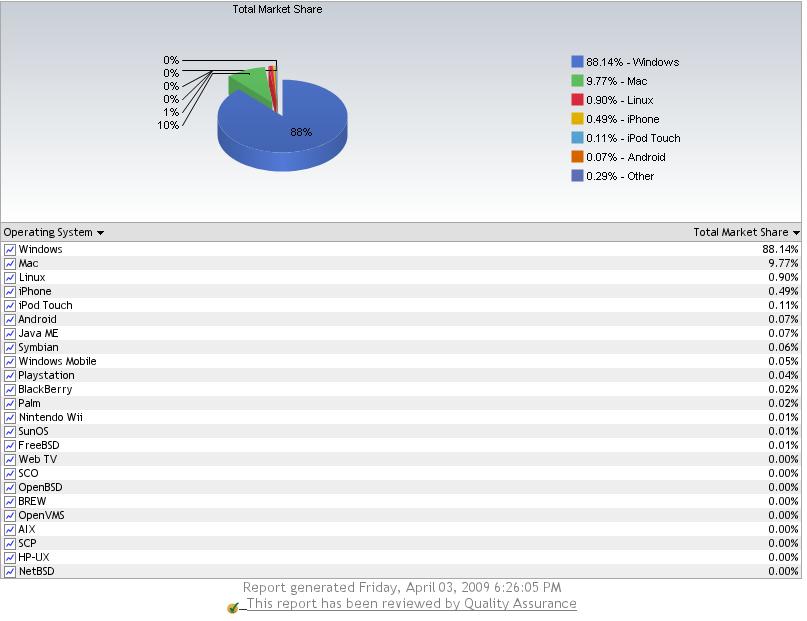
4. I found a pie chart representing the market share. I've posted it below. Here is the link as well.

Wednesday, September 23, 2009

Day 7: Lab 2

After cracking the code we found the text to be: Be sure to drink your Ovaltine. We converted the binary using an online ASCII converter.

In the code, each 8 numbers is one letter. So:

01000010 = B which decimal equivalent is 68
01100101 = e
00100000 = Space
01110011 = S


And so on.

Day 7: Lab 1


We decided to use a system similar to the binary code. For example, the first word in the latin phrase, lorem, would be punched like this:

L O R E M
12 15 19 5 13


Here is exactly how it would be punched on the card (the highlighted numbers are punches):


Monday, September 21, 2009

Day 6: How to Read a Punch Card


Deciphering punch cards is as hard as it looks. I don't know how anyone ever decided this was an efficient means of storing information. Nonetheless, today in class we attempted to read these cards. These are the steps used:

How to use a punch card:

1. Find a punch card key that looks similar to this (I have also posted a similar picture below). We used IBM 80-column punch cards.


2. Notice they ABCDEFGHI... at the top of the card.


3. Now look at the holes punched under the letter A. There is 1 hole in Row 12 and 1 Hold in Row 1. That is the punch code for the letter A. The rest of the alphabet has its own corresponding holes (or punch code). Numbers 0 - 9 and a few extra symbols also have their own punch code.


Good luck!


Wednesday, September 16, 2009

Day 5

Reverse engineering is the process of analyzing the construction and operation of a product in order to manufacture a similar one. In the film, Compaq studied the design of IBM's computers in order to create identical versions of their own.

According to Wikipedia--which I usually find to be a legitimate source for information--referse engineering software or hardware systems is usually legal.

But I do know, in the ethics of fashion design, producing garments identical to that of another designers is illegal and frowned upon. Stores like Forever 21 and H&M have been accused and even sued by designers like Trovata, Diane Von Furstenberg, Marc Jacobs, and Gwen Stefani for recreating items from their collections and selling them for next to nothing.

Monday, September 14, 2009

Day 4: Fellow Student's Burning Question Answered

Here is a link to my answer to Jess' question about internal hard drives vs. external hard drives.

Monday, September 7, 2009

Day 2: Hardware

After today's talk, what is the one burning question you still want answered about hardware?

I used to play a lot of computer games in middle school. I was that one girl in the pitch black gaming station with a hot pocket and a Diet Coke playing Age of Empires or WoW. But middle school was years ago. I was wondering what kind of expansion pieces gamers are adding to their computers today to get the most out of gaming.

Wednesday, September 2, 2009

Revenge of the Nerds

The documentary proliferated 3 stereotypes of computer nerds:
  1. diet consists of stale pizza and Coke
  2. four-eyed males clueless about hygiene and girls
  3. used their garages for computing instead of cars

Many of these stereotypes remain relevant today. And only because many of them still hold some truth. If you walk into a gamer store today you'll see over weight men with glasses, eating things like hot pockets, pizza, and Coke. They have little social skills and almost not hygenic routine. One thing I've found true about computer enthusiasts is that there is no specific age range. I've seen people from age 13 to 30 having discussions about computers.

CSC 111: First Post

I am a Strategic Communications major/Women's Studies minor. My name is Dawn. I am currently a sophomore. I chose this class to fill the Science requirements for graduation. The course catalog description seemed feasible, or more so than others, so I added it to my schedule. Hopefully I won't end up too disappointed or overwhelmed.